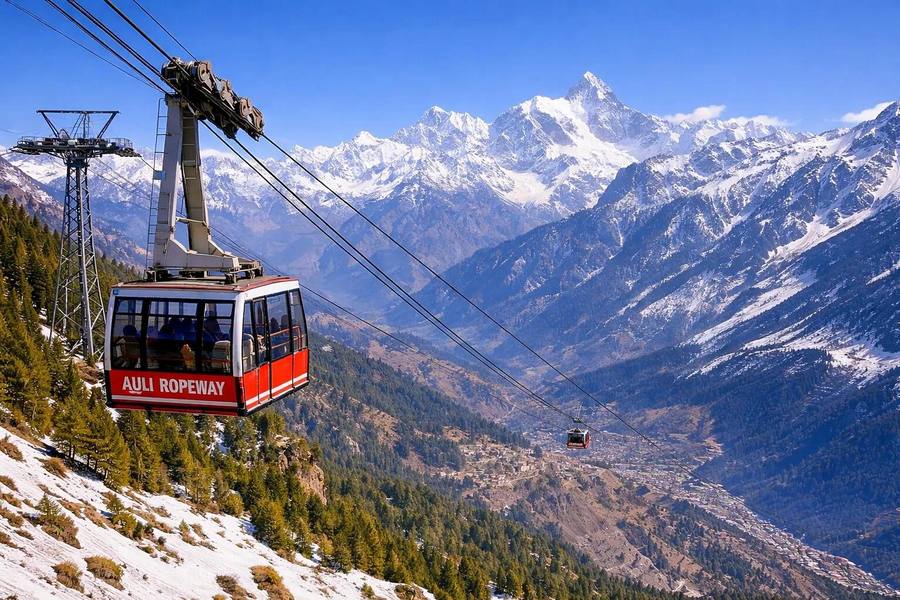
 6 Days · 5 NightsThe Alpine Sojourn
Mussoorie & Auli Highlands
Cloud-level promenades and snowfield picnics across Uttarakhand's finest hills.
From₹27,999
View PackageCloud-level promenades and colonial-era charm.
Mussoorie sits on a long ridge above the Doon Valley at around 2,000 metres, and on a clear evening you can stand on the Mall and see the lights of Dehradun laid out below you on one side and the snow line of the Garhwal Himalaya on the other. The British built it as a summer retreat in the 1820s and the bones of that town are still visible everywhere — church spires, iron railings, a library at one end of the promenade, hotel names in a serif from another century. Hence the nickname, the Queen of the Hills, which the town has never once been shy about using.
The Mall Road is the spine of it: a two-kilometre promenade of tea rooms, bookshops, woollens and hot roasted corn, closed to most traffic and best walked slowly in the late afternoon. Gun Hill, the second-highest point in town, is reached by a short ropeway and gives a 360-degree panorama that takes in Bandarpunch, Srikanta and the Gangotri group on a clear day. Camel's Back Road, a level three-kilometre walk around the north face, is where locals go at sunset and where the rock formation that gives the road its name is genuinely, undeniably shaped like a camel.
Kempty Falls, fifteen kilometres out on the Yamunotri road, is the famous one and the most crowded; we usually suggest going early or skipping it in favour of Jharipani and Bhatta falls, which are quieter. Company Garden is a pleasant hour with children, Lal Tibba at Landour is the highest point with a telescope pointed at the peaks, and Cloud End, a Scottish-built house from 1838 at the far western end of the ridge, is a lovely place to have lunch surrounded by deodar forest.
What we always recommend, though, is Landour — the old cantonment a steep four kilometres above the Mall, where Ruskin Bond has lived and written for decades. It has almost none of Mussoorie's noise: four roads meeting at Char Dukan, a handful of bakeries and cafés, colonial cottages under deodars, and a walking loop with views straight into the mountains. March to June is the classic season, September to November gives the cleanest air and the best peak views, and late December through January occasionally delivers snow.
The lively colonial-era promenade lined with cafés, shops and viewpoints.
Mussoorie’s most popular cascade, perfect for a refreshing stop.
The second-highest point, reached by ropeway, with Himalayan panoramas.
A gentle walking trail famed for its golden-hour sunset views.
A quiet colonial cantonment above town, all deodar lanes and old bakeries.
6 Days · 5 NightsThe Alpine SojournCloud-level promenades and snowfield picnics across Uttarakhand's finest hills.
Late December to January occasionally sees snowfall in Mussoorie.
Yes — the quiet colonial cantonment above Mussoorie is a highlight for many guests.
Our concierge will craft a private itinerary around your dates, group and pace.
No call centre, no scripts. You reach the same Haridwar office that dispatches the car — any hour, any day, in Hindi or English.